
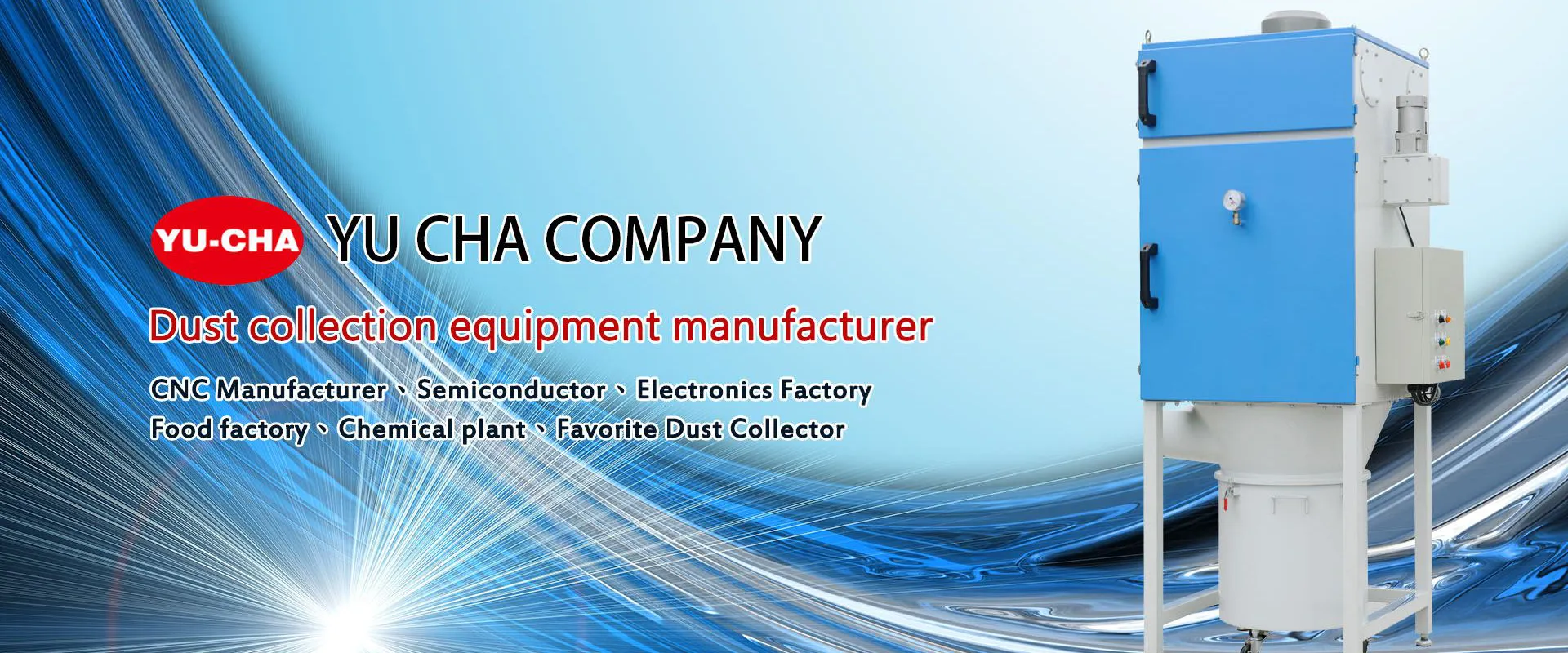
22.Compact Industrial Dust Collector | YUCHA: 50% Smaller Footprint, 100% Suction Power
How to Choose an Industrial Dust Collector: Breaking the "High HP = Bulky Size" Myth with YUCHA’s 50% Smaller Footprint
[Key Takeaway: Why Choose a Compact, Same-Horsepower Industrial Dust Collector?]
Traditional industrial dust collectors often rely on oversized housings and inefficient internal airflow paths, consuming valuable manufacturing floor space. YUCHA Dust Collectors overcome this limitation through advanced fluid dynamics and compact structural engineering. Within the exact same capacity class and horsepower (HP), YUCHA reduces overall equipment volume by over 50% compared to conventional brands while maintaining 100% rated airflow (CFM/CMM) and static pressure. This breakthrough frees up more than half the floor footprint for revenue-generating machinery, enables machine-side (point-of-use) installation, minimizes ductwork static pressure loss, and lowers long-term energy consumption.
In modern manufacturing, every square foot of factory floor space directly impacts your bottom line. Yet facility managers and plant engineers frequently face a frustrating dilemma when upgrading air filtration systems: meeting environmental and occupational safety standards requires high-horsepower dust collectors, but traditional heavy-duty units are massive, bulky, and eat into vital production areas.
Does high horsepower always require a massive footprint? This guide examines why conventional dust collectors waste space and how YUCHA engineers industrial dust collectors that are over 50% smaller in volume than competing units of the same horsepower—without sacrificing a single fraction of suction performance.
Why Are Traditional Industrial Dust Collectors So Bulky?
For decades, most industrial dust collector manufacturers have relied on legacy cabinet designs. When scaling up horsepower (HP) and airflow capacity, the standard industry approach has been to simply enlarge the outer sheet-metal housing to fit motors, blowers, filter media, and dust hoppers. This outdated design creates three major operational bottlenecks:
-
Excessive Internal Dead Space: Conventional airflow routing is often coarse and unoptimized, leaving large pockets of unused volume inside the housing and inflating the machine's exterior dimensions.
-
Forced Outdoor or Remote Installation: Because bulky units cannot fit into existing production lines, plants are forced to install them outdoors or in distant corners—resulting in expensive, complex, long-distance ductwork engineering.
-
Crowded Production Lines & Blocked Aisles: Squeezing a traditional dust collector indoors takes up valuable square footage that could house production equipment, while obstructing forklift lanes and creating workplace safety hazards.
The YUCHA Breakthrough: Same Class, Same Horsepower, Over 50% Smaller Volume
To solve the manufacturing industry's demand for maximum suction in a minimal footprint, YUCHA re-engineered the industrial dust collector from the ground up. Comparing units of the exact same horsepower and capacity class, YUCHA dust collectors are more than 50% smaller in overall volume than other brands on the market. This achievement is driven by two core engineering innovations:
1. Precision Airflow Dynamics & Compact Structural Engineering
The YUCHA engineering team recalculated the trajectory of dust-laden air from intake to exhaust. By eliminating redundant cabinet structures and implementing an optimized, streamlined internal airflow path, air deceleration, heavy particle settling, and fine filtration occur within a significantly shorter travel distance. This completely eliminates internal dead zones and shrinks the external housing by over half.
2. Uncompromised 100% Static Pressure and Airflow (CFM)
A common question from plant managers is: "If the machine is half the size, does it lose suction power?" In aerodynamic engineering, dust collector performance is determined by motor power, blower impeller efficiency, and effective filtration media area—not the size of the outer metal box. YUCHA utilizes high-density filter configurations paired with high-efficiency centrifugal blowers, ensuring that a unit half the physical size still delivers 100% of the static pressure and airflow volume of a traditional oversized unit.
4 Major Operational Benefits of Reducing Dust Collector Footprint by 50%
Cutting equipment volume in half delivers far more than a cleaner-looking factory floor—it directly improves capital efficiency, energy consumption, and plant management across four key areas:
Benefit 1: Maximize Factory Floor Space ROI for Production Lines
Industrial real estate and factory leases are expensive. When a YUCHA dust collector saves over 50% of floor space, that reclaimed square footage can be used to install additional CNC machines, robotic arms, assembly stations, or raw material staging areas. You effectively convert non-revenue utility space into profit-generating production capacity.
Benefit 2: Enable "Point-of-Use" Collection to Slash Static Pressure Loss & Energy Costs
In fluid mechanics, the longer a dust collection duct runs—and the more elbows and bends it contains—the higher the static pressure loss (friction loss) inside the pipe, which severely weakens suction at the dust hood.
-
The Traditional Way: Oversized collectors must be placed far away, requiring long duct runs and forcing buyers to purchase even larger, power-hungry motors just to overcome duct resistance.
-
The YUCHA Advantage: With a volume reduced by over 50%, YUCHA units easily fit into tight corners, between structural pillars, or directly beside processing machinery (point-of-use / machine-side dust collection). Shorter ductwork minimizes pressure loss, maximizes capture velocity at the hood, cuts piping installation costs, and reduces ongoing electricity bills.
Benefit 3: Clear Aisle Workflows and Enhance Workplace Safety
Shrinking the collector footprint by half prevents equipment from protruding into walkways and work zones. Forklift turning radii, overhead crane paths, and operator walkways remain clear and unobstructed. This eliminates congestion, accelerates material handling, and significantly reduces workplace collision risks.
Benefit 4: Effortless Retrofitting and Flexible Production Line Relocation
For older facilities with maxed-out floor plans, multi-story industrial buildings, or low-ceiling workshops, bringing in a conventional dust collector often requires knocking down walls, removing doors, or hiring heavy cranes. YUCHA’s compact frame easily passes through standard factory doorways and freight elevators. Furthermore, when production lines are reconfigured or relocated in the future, moving and re-piping a YUCHA unit takes less than half the time and labor cost.
YUCHA vs. Conventional Same-Class Dust Collectors: Side-by-Side Comparison
The table below compares YUCHA against standard market competitors under the exact same horsepower (HP) and airflow specifications:
| YUCHA Dust Collector (Compact Same-HP) | Conventional Competitor (Standard Bulky Unit) | Core Value YUCHA Delivers to Your Plant | |
| Equipment Volume & Footprint | Reduced by Over 50% (Ultra-Compact) | 100% (Traditional Oversized Cabinet) | Frees up more than half the floor space for production |
| Horsepower & Suction Output | 100% Full-Load Airflow & Static Pressure | 100% Standard Output | Zero compromise on suction power or dust capture |
| Installation Flexibility | Machine-side, corners, or tight dead spaces | Requires large dedicated room or outdoor pad | No structural modifications needed; fits dense layouts |
| Ductwork Distance | Minimal (Placed right next to dust source) | Long (Forced far from machinery due to size) | Drastically reduces static pressure loss, piping & power costs |
| Impact on Plant Workflow | Minimal; preserves wide aisles | High; often blocks forklifts and walkways | Improves material handling speed and floor safety |
| Future Relocation Ease | High; easy to rig, move, and re-pipe | Low; requires major teardown and rigging | Adapts quickly to production line changes at low cost |
How to Choose the Right Compact Dust Collector for Your Facility (3-Step Guide)
If you are planning a new production line or upgrading an aging dust collection system, follow these three steps to optimize both air quality and floor space:
-
Step 1: Identify Dust Characteristics and Required Airflow
Determine the type of particulate generated by your process (e.g., metal grinding dust, wood chips, plastic powder, laser cutting fumes) and calculate the required capture velocity and total airflow (CFM / CMM) to select the exact horsepower class needed.
-
Step 2: Audit Available Machine-Side Space and Ceiling Height
Measure the unused gaps next to your processing machines, pillar corners, and overhead clearances. With YUCHA’s 50%+ volume reduction, narrow spaces previously deemed "unusable" often become the ideal installation spot.
-
Step 3: Prioritize Short-Duct, Low-Loss Layout Designs
Select a compact dust collector that can be positioned right next to the emission source. Minimizing duct length keeps static pressure loss to an absolute minimum, saving you from overpaying for oversized motors just to compensate for long piping runs.
Frequently Asked Questions (FAQ) — 10 Essential Questions About YUCHA Compact Dust Collectors
Q1: Since YUCHA dust collectors are over 50% smaller in volume, is the suction power or airflow weaker?
No. A dust collector’s suction power (static pressure) and airflow (CFM/CMM) are determined by motor horsepower, impeller efficiency, and effective filter area—not the external size of the sheet-metal housing. Within the same horsepower class, YUCHA retains 100% full-load motor output and filtration capacity, delivering the exact same suction performance as units twice its size.
Q2: How does YUCHA reduce the dust collector size by more than 50% compared to other brands of the same horsepower?
YUCHA utilizes advanced computational fluid dynamics (CFD) and compact mechanical engineering to redesign the internal air intake channels, filter arrangement, and blower integration. By eliminating the large internal dead zones and redundant housing space found in traditional designs, YUCHA cuts overall volume by over half without sacrificing performance.
Q3: Does a 50% smaller housing mean the internal filter media surface area is also reduced?
No. YUCHA incorporates high-density, high-efficiency filter media configurations that pack the full required filtration surface area into a streamlined internal chamber. Both dust filtration efficiency and filter service life remain at peak industrial standards.
Q4: What is "point-of-use" (machine-side) dust collection, and how is it better than a centralized system?
"Point-of-use" dust collection means installing the dust collector directly beside the specific machine generating the dust. Because YUCHA units are over 50% smaller, they easily fit right next to production equipment. Benefits include the shortest possible ductwork (lowest pressure loss and strongest suction), zero expensive main-trunk piping costs, and significant energy savings since you only run the collector when that specific machine is operating.
Q5: How does placing the dust collector closer to the processing machine affect suction performance?
The closer the dust collector is to the dust source, the shorter the connecting duct and the fewer bends required. This drastically reduces internal friction and static pressure loss, ensuring that 100% of the blower's suction power is applied directly at the extraction hood rather than wasted inside long pipes.
Q6: Our factory floor is extremely crowded (or located on an upper floor). Is YUCHA suitable for tight spaces?
Yes, it is ideal. Space-constrained facilities are where YUCHA delivers the highest value. Cutting volume by over 50% allows the unit to fit into tight machine gaps, beside structural columns, or under low ceilings. Its compact dimensions also allow it to fit into standard freight elevators and doorways without knocking down walls.
Q7: Which industries benefit most from YUCHA’s high-horsepower, small-footprint dust collectors?
Any manufacturing sector that requires powerful dust extraction while maximizing floor space ROI will benefit—especially high-density facilities in metalworking (grinding, polishing, CNC machining), woodworking and furniture manufacturing, plastics and composites, food and chemical powder processing, and electronics manufacturing.
Q8: What hidden costs can a factory save by choosing a YUCHA dust collector that is half the size?
Beyond saving over 50% in occupied floor space value (which can be used for revenue-generating machines), factories save on long-distance ductwork materials and installation labor, building modification or outdoor foundation costs, long-term electricity bills (due to lower static pressure loss), and future rigging costs when rearranging production lines.
Q9: Does upgrading an existing factory to YUCHA dust collectors require long production downtime?
No. Because YUCHA units are compact and highly flexible in placement, they can be positioned directly into existing floor gaps and connected quickly without structural demolition or major plant remodeling, keeping production downtime to an absolute minimum.
Q10: How can we evaluate which horsepower and model of YUCHA dust collector fits our facility?
You can contact the YUCHA engineering team directly for a comprehensive site and application assessment. We analyze your dust particulate characteristics, machine count, required airflow (CFM/CMM), and available floor dimensions to engineer a custom, space-saving dust collection solution.
Don't let bulky, outdated filtration equipment limit your factory's production capacity. By delivering 100% industrial suction power in less than 50% of the volume, YUCHA Dust Collectors help manufacturers worldwide solve floor space bottlenecks while maintaining a clean, safe, and compliant working environment.
Ready to reclaim your factory floor space?
👉 [Contact a YUCHA Specialist Today] or [Request a Free Plant Dust Collection Assessment] to discover how much space and energy your facility can save!